
质心的基础
需要注意的是,在横截面上, 整个区域面积均匀, 质心可以通过将相对于任意设置的轴的力矩之和求出, 但通常设置在顶部或底部光纤. 查看我们之前的文章 本文将指导您完成如何计算质心的简单过程 梁截面和 SkyCiv 免费质心计算器.
从根本上, 质心可以通过将面积总和上的矩求和来获得. 用这种方式表示.
[math]
\bar{x}=\frac{1}{A}\int xf\left ( x \right )dx
[math]
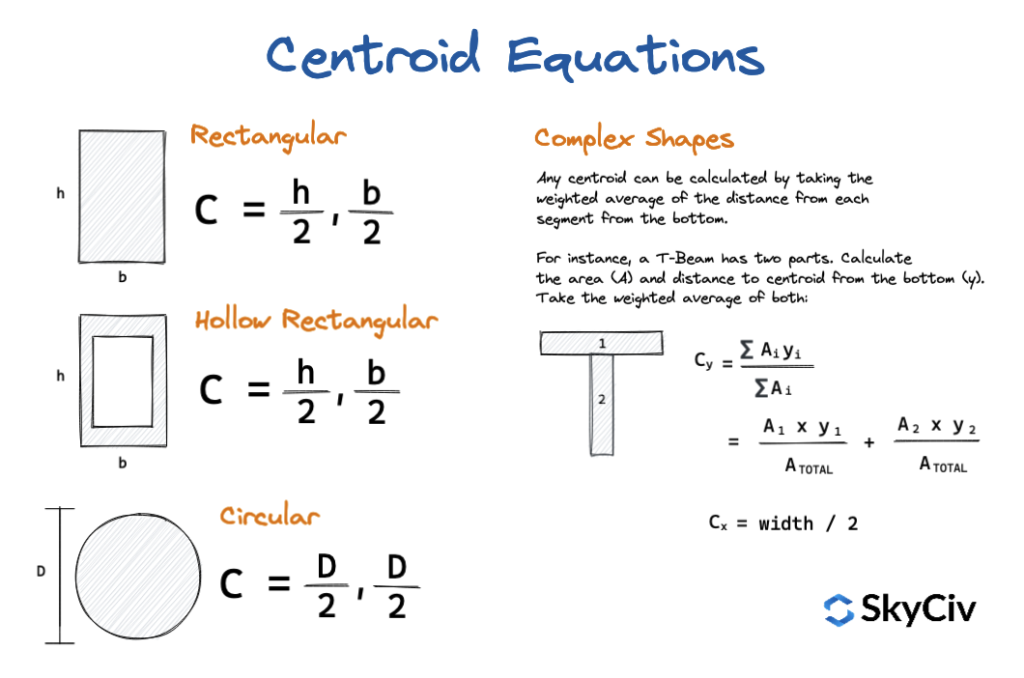
质心方程总结
在上式中, F(X) 是函数,x是力矩臂. 为了更好地说明这一点, 我们将推导其底与x轴重合的任意三角形的y重心. 在这种情况下, 三角形的形状, 是否平等, 等腰或斜角无关紧要,因为一切都只相对于x轴. 请注意,如果三角形的底边与轴重合或平行,则形状无关紧要. 求解x重心时情况并非如此. 代替, 您可以想象它是相对于y轴获得两个直角三角形的质心. 为了方便起见, 让我们想象一个等腰三角形类似于下面的参考表. 找到 b 和 h 之间的关系将得出以下关系.
[math]
\frac{-y}{x}=\frac{-h}{b}
[math]
注意,当我们想象三角形是直立的时,斜率是负的. 如果我们想象三角形是倒置的, 斜率是正的. 而不管, 关系保持不变. 当x = f(和), 上面的关系可以改写如下.
[math]
x=f\left ( y \right )=\frac{b}{h}y
[math]
我们现在可以解决质心. 调整上面的第一个方程, 我们得到以下.
[math]
\bar{y}=\frac{1}{A}\int yf\left ( y \right )dy
[math]
插入其他值并替换上面的关系将得出以下公式.
[math]
\bar{y}=\frac{2}{bh}\int_{0}^{h} \frac{b}{h}y^{2}dy
[math]
简化,
[math]
\bar{y}=\frac{2}{h^{2}}\left [ \frac{y^{3}}{3} \right ]_{0}^{h}
[math]
[math]
\bar{y}=\frac{2}{h^{2}}\left [ \frac{h^{3}}{3}-0 \right ]
[math]
[math]
\bar{y}=\frac{2}{3}h
[math]
请注意,此解决方案取自顶部. 那么从底部截取的质心必须等于 1/3 的h.
常见形状和梁截面的质心公式
下面是一个列表 各种梁截面形状 以及到截面质心的距离. 这些方程式说明如何从截面的底部或最左端找到特定截面的质心. 对于SkyCiv Student和Structural订阅, 此参考也可以下载为PDF参考,以便随身携带. 梁截面的质心非常重要,因为它们定位中性轴,并且是分析梁截面时所需的最早步骤之一.
SkyCiv 还提供全面的截面摘要表,其中包含与梁截面有关的所有方程式和公式 (惯性矩, 地区等…).
下面列出了各种质心的方程式:
| 参考 | C和 (距底的距离) |
CX (距最左点的距离) |
矩形或矩形截面的质心 |
||
|---|---|---|
 |
[math] \dfrac{h}{2} [math] |
[math] \dfrac{b}{2} [math] |
空心矩形截面的质心 |
||
 |
[math] \dfrac{b}{2} [math] |
[math] \dfrac{h}{2} [math] |
圆形或圆形截面的质心 |
||
 |
[math] \dfrac{D}{2} [math] |
[math] \dfrac{D}{2} [math] |
空心圆截面的质心方程 |
||
 |
[math] \dfrac{D}{2} [math] |
[math] \dfrac{D}{2} [math] |
等腰三角形的质心 |
||
 |
[math] \dfrac{h}{3} [math] |
[math] \dfrac{b}{2} [math] |
工字梁的质心 |
||
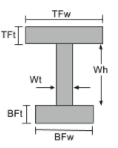 |
[math] \frac{TFw\times TFt\times \left ( BFt + Wh + \frac{TFt}{2} \right )}{TFw\times TFt + Wt\times Wh + BFw\times BFt} + [math] [math] \frac{Wt\times Wh\times \left ( BFt + \frac{Wh}{2} \right )}{TFw\times TFt + Wt\times Wh + BFw\times BFt} + [math] [math] \frac{BFw\times BFt\times \left ( \frac{BFt}{2} \right )}{TFw\times TFt + Wt\times Wh + BFw\times BFt} [math] |
[math] TFw > BFw, \frac{TFw}{2}[math] [math] BFw > TFw, \frac{BFw}{2} [math] |
T型截面的质心 |
||
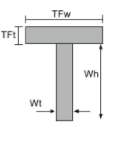 |
[math] \frac{Wt\times Wh\times \left ( \frac{Wh}{2} \right )}{TFw\times TFt + Wt\times Wh } + [math] [math] \frac{TFw\times TFt\times \left ( Wh + \frac{TFt}{2} \right ) }{TFw\times TFt + Wt\times Wh } [math] |
[math] \frac{TFw}{2} [math] |
C部分的质心 |
||
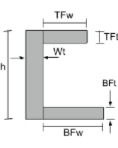 |
[math] \frac{TFw\times TFt\times \left ( h – \frac{TFt}{2} \right )}{TFw\times TFt + Wt\times Wh + BFw\times BFt} + [math] [math] \frac{Wt\times h\times \left ( \frac{h}{2} \right )}{TFw\times TFt + Wt\times Wh + BFw\times BFt} + [math] [math] \frac{BFw\times BFt\times \left ( \frac{BFt}{2} \right )}{TFw\times TFt + Wt\times Wh + BFw\times BFt} [math] |
[math] \frac{TFt\times TFw\times \left ( Wt + \frac{TFw}{2} \right )}{TFt\times TFw + h\times Wt + BFt\times BFw} + [math] [math] \frac{h\times Wt\times \left ( \frac{Wt}{2} \right )}{TFt\times TFw + h\times Wt + BFt\times BFw} + [math] [math] \frac{BFt\times BFw\times \left ( Wt + \frac{BFw}{2} \right )}{TFt\times TFw + h\times Wt + BFt\times BFw} [math] |
角质心 |
||
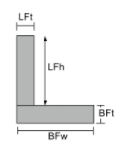 |
[math] \frac{LFt\times LFh\times \left ( BFt + \frac{LFh}{2} \right ) }{LFt\times LFh + BFw\times BFt} + [math] [math] \frac{BFw\times BFt\times \left ( \frac{BFt}{2} \right )}{LFt\times LFh + BFw\times BFt} [math] |
[math] \frac{LFh\times LFt\times \left ( \frac{LFt}{2} \right )}{LFh\times LFt + BFt\times BFw} + [math] [math] \frac{BFt\times BFw\times \left ( \frac{BFw}{2} \right )}{LFh\times LFt + BFt\times BFw} [math] |
梁质心的自动方程
看看我们的 本文将指导您完成如何计算质心的简单过程, 的简化版本 SkyCiv版块生成器, 自动计算梁的质心,无需手工计算. 或今天注册开始!
